1932
Hoffa’s Strawberry Strike
At nineteen, [Jimmy Hoffa](entity:character-recall-character-jimmy-hoffa-b893428a16ef) led [Detroit](entity:location-recall-location-detroit-c63f400ec324) grocery workers known as the Strawberry Boys in a brief strike against [Kroger](entity:organization-recall-organization-kroger-bc6383b774fd). The men refused to unload strawberries until the company recognized their union and guaranteed minimum pay for part of their long shifts.
Kroger yielded, giving Hoffa his first organizing victory and setting him on the path to national labor power. The book presents the episode as an early example of his belief that disciplined solidarity could force employers to negotiate.
1920s and 1930s
Sheeran’s Depression Childhood
Born in 1920 into a poor Irish Catholic family in [Philadelphia](entity:location-recall-location-philadelphia-375889b6054c), [Frank Sheeran](entity:character-recall-character-frank-sheeran-3e01b0f4cdc4) grew up amid rent arrears, hunger, and frequent moves. His father sent him to steal produce from New Jersey farms, and his mother picked birdshot from his backside after farmers chased him away.
At home, his father used boxing gloves to punish him, while the boy learned to fight, work, and fend for himself. The book traces the toughness and emotional distance of his childhood as an early foundation for the violence he would later treat as ordinary.
1913–1930s
Hoffa’s Early Hardship
Born in 1913, [Jimmy Hoffa](entity:character-recall-character-jimmy-hoffa-b893428a16ef) lost his coal-miner father when he was seven. His mother worked in an auto plant, and Hoffa left school at fourteen to help support the family.
The hardship of the [Great Depression](entity:time-recall-time-great-depression-1a196e2fd6b1) shaped the labor leader’s eventual appeal to workers who had little leverage against employers. The book sets his rise alongside the struggles of Sheeran’s generation, though their paths to power would be profoundly different.
1932
The Bonus Army’s Expulsion
As Hoffa’s Strawberry Boys won their strike, thousands of World War I veterans marched on [Washington, D.C.](entity:location-recall-location-washington-d-c-2a63ac520a1d), seeking early payment of promised bonuses. President Herbert Hoover ordered the Army to clear them from the capital.
The attack on the veterans, including the use of troops and tear gas, became a stark example of the powerlessness of working people in the Depression. The book places this episode beside Hoffa’s small but consequential victory for organized labor.
1933
Hoffa Becomes an Organizer
[Kroger](entity:organization-recall-organization-kroger-bc6383b774fd) refused to renew the agreement won by the Strawberry Boys, but the strike had made Hoffa visible. [Detroit](entity:location-recall-location-detroit-c63f400ec324)’s Teamsters recruited him as an organizer, giving him a foothold in the labor movement.
In a city where employers relied on strikebreakers and violence, Hoffa learned to build power through organization and confrontation. That atmosphere also helped create the conditions in which unions and criminal muscle would become entangled.
Mid-1930s
The Carnival Road
After being expelled from high school, Sheeran joined a traveling carnival with his friend Francis “Yank” Quinn. He worked as a laborer and ticket collector, sleeping under trucks and following the show through New England.
In Vermont, the carnival’s performers, Little Egypt and Neptune of the Nile, initiated the seventeen-year-old into adult sexual life. The experience became one of his flamboyant memories of youth, before war and organized crime narrowed his world.
Late 1930s
Logging Camp Fights
When the carnival season ended, Sheeran and Quinn walked to a Maine logging camp and found work. Sheeran spent nine months sawing timber and fighting older men in rough, improvised boxing matches.
He remembered the camp as a school for endurance and violence. The physical confidence he acquired there would later serve him in labor conflicts and in the criminal errands that earned him a reputation.
1939
The Harvest Moon Contest
Working as a glazier and dancing regularly, Sheeran partnered with Roseanne De Angelis after her original partner was injured. Together they took second place in the Harvest Moon Ball fox-trot contest at Madison Square Garden.
The achievement captured a version of Sheeran’s life that still seemed open and ordinary: steady work, friends, music, and ambition. He would later teach his daughters to dance, even as his family life became increasingly fractured.
August 1941
Sheeran Enlists
Sheeran enlisted in the Army and was initially assigned to military police duty. After the attack on Pearl Harbor, he volunteered for combat and tried to join the paratroopers, but a training injury dislocated his shoulder and sent him to the infantry instead.
He was assigned to the [45th Infantry Division](entity:organization-recall-organization-45-a15184d05576), where his boyhood friend Charlie “Diggsy” Meiers served. The choice to leave a comparatively safe post would expose Sheeran to years of combat and, as he later understood it, teach him to kill without hesitation.
1942–1943
Patton’s Killer Division
General [George S. Patton](entity:character-recall-character-s-fe65a172921a) addressed the young men of the [45th Infantry Division](entity:organization-recall-organization-45-a15184d05576) before their deployment, urging them to kill and warning them not to accept some enemy surrenders. The division acquired the grim reputation of a “Killer Division.”
Sheeran recounts these speeches alongside the killings of disarmed prisoners at Biscari, where soldiers were court-martialed and Patton’s words figured in the controversy. The episode complicates the book’s portrayal of Sheeran’s later violence: he entered combat within a command culture that blurred obedience and atrocity.
July 1943
The Sicily Landing
Sheeran landed in [Sicily](entity:location-recall-location-sicily-8d99f798a76e) as an infantry rifleman and was welcomed by Diggsy, who handed him a shovel and told him to dig a foxhole. He had volunteered for action, but the reality of incoming shells immediately replaced his romantic ideas about combat.
The campaign exposed him to death, fear, and the practical rules of survival. The book identifies this as the beginning of the combat experience that would later make violence feel less exceptional to him.
September 1943
The Salerno Beachhead
During the Allied landing at [Salerno](entity:location-recall-location-salerno-f0db2d865df7), Sheeran and his squad came ashore under German artillery and aircraft fire. His friend Alex Siegel was killed in a strafing, and Sheeran remembered the terror of digging in while the Germans threatened to push the invaders back into the sea.
He could not recall the first time he fired at an enemy soldier. That blankness, set against the danger and loss around him, foreshadowed the emotional hardening he later described as a survival mechanism.
Late 1943–January 1944
The Monte Cassino Front
Sheeran’s unit pushed north toward Rome and spent months under fire near [Monte Cassino](entity:location-recall-location-monte-cassino-775f468eb083). Replacements arrived and died before their boots had dried, while Sheeran tried to limit his attachments to the few men he could bear to lose.
Diggsy was wounded twice, deepening Sheeran’s sense that even close friendship could not protect anyone in combat. The cold, exhaustion, and repeated exposure to death further narrowed his emotional life.
January–May 1944
The Anzio Dugouts
The 45th Division landed at [Anzio](entity:location-recall-location-anzio-e6617d9ed129) and was pinned down for four months. Sheeran described living in deep dugouts under relentless shelling, rationing food, keeping watch at night, and listening for the German artillery piece known as the [Anzio Express](entity:object-recall-object-anzio-express-f8d0f02d7342).
The sustained danger made fear routine and death familiar. Sheeran later connected this period to his ability to carry out violent orders without stopping to consider their human meaning.
August 1944
The Southern France Landing
Sheeran took part in [Operation Dragoon](entity:event-recall-event-a8c25f6e2632), the Allied landing in southern [France](entity:location-recall-location-france-f5cafc8a8ad4). As he ran onto the beach at Saint-Tropez, he thought he had been shot until a lieutenant pointed out that German fire had punctured his canteen and covered him with wine.
The episode gave him a moment of dark humor amid a campaign that continued to expose him to danger. He later fought through Alsace-Lorraine and watched a fellow soldier deliberately risk losing a leg to escape combat, only to have the leg severed.
Late 1944
Diggsy’s Rifle
During a firefight in Alsace-Lorraine, Diggsy was hit halfway up a hill. Sheeran crawled back under fire to retrieve his friend’s rifle, risking his own life for a piece of equipment that could be replaced.
The act revealed that the combat had not erased every attachment. Sheeran’s loyalty to Diggsy persisted even as he claimed to have little emotion left, and he joked that the Germans had not realized they were outnumbered.
Spring 1945
The Dachau Liberation
As the [45th Infantry Division](entity:organization-recall-organization-45-a15184d05576) advanced through [Germany](entity:location-recall-location-germany-2e3723c2f347), it reached [Dachau concentration camp](entity:location-recall-location-dachau-concentration-1f8a9fe6aa83). Sheeran recalled the sight and smell of bodies, the liberation of the prisoners, and the killing of German guards after the camp was taken.
The experience remained permanently imprinted on him. In his later account, the camps and the repeated deaths of soldiers helped erase the moral habits he had brought from civilian life.
October 1945
Home from the War
Sheeran and his younger brother Tom met by chance in [France](entity:location-recall-location-france-f5cafc8a8ad4) while waiting to return home. Tom told him that he had changed, and Sheeran recognized the truth of it: he had become indifferent to ordinary concerns and had learned to live with death.
Back in [Philadelphia](entity:location-recall-location-philadelphia-375889b6054c), he could not remain at his old glazier’s job and slept only a few hours at a time. He described the war as having encased him in a hard inner shell, a condition he carried into his postwar relationships and work.
Late 1940s
The Kangaroo Fight
At a carnival, Sheeran agreed to box a trained kangaroo for prize money. He did not realize that the animal could strike him with its tail, and he became distracted by Mary Leddy, a young woman watching from the crowd.
After the bout ended in a brawl involving the referee and the police, Sheeran went to Mary’s home and asked her out. Their first date was to see the bandleader Erskine Hawkins, and Sheeran believed he had found the woman he would marry.
1947
Sheeran Marries Mary
Sheeran and Mary Leddy married at Mother of Sorrows Church. He borrowed money from several finance companies to pay for the wedding, then fought a collector who tracked him to his job.
The couple began married life in her parents’ home and struggled to establish a stable household. Sheeran’s quick temper and uncertain employment were already in tension with Mary’s quiet, devout nature.
Late 1940s–1950s
A Family and a Meat Route
Mary and Sheeran had three daughters, and he found steady work driving a [Food Fair](entity:organization-recall-organization-food-fair-46d5fdc67d49) truck. With help from his friend [Dusty Wilkinson](entity:character-recall-character-a202cba016f4), he began diverting chickens from his deliveries and selling them for cash.
The side business brought money into the household, but it also established Sheeran’s habit of treating theft as a practical extension of work. He later expanded the scheme to stolen meat and other criminal hustles.
About 1955
Sheeran Meets Bufalino
When his truck broke down near Endicott, Sheeran met [Russell Bufalino](entity:character-recall-character-russell-bufalino-c2b6ec67a0da), who stopped to help repair it. The two men liked each other immediately, and their acquaintance grew through meals, wine, and repeated meetings in [Philadelphia](entity:location-recall-location-philadelphia-375889b6054c) and [Pennsylvania](entity:location-recall-location-pennsylvania-df47ee289232).
Sheeran did not initially understand the scale of Bufalino’s criminal power. He brought him prosciutto bread and sausage, drove him on errands, and slowly became a trusted associate whose presence beside Bufalino brought both opportunity and danger.
November 1957
The Apalachin Raid
Bufalino asked Sheeran to drive him to a gathering in [Apalachin](entity:location-recall-location-apalachin-de7c09a42854), where police raided a meeting of mob figures from across the country. Sheeran had dropped Bufalino off without realizing the importance of the gathering.
The arrests made organized crime a national public reality and revealed to Sheeran that his new friend belonged to a much larger network. His association with Bufalino had moved him closer to a world whose rules he barely understood.
Late 1950s
Whispers’s Arson Contract
A moneylender known as [Whispers DiTullio](entity:character-recall-character-whispers-ditullio-bc6955b60ab1) offered Sheeran a large payment to destroy Cadillac Linen Service, promising that the damage would restore business to a company in which Whispers had invested. Sheeran began surveying the plant and planning the arson.
At [Angelo Bruno](entity:character-recall-character-angelo-bruno-7b9540f1b2a1)’s restaurant, Sheeran learned that Bruno himself had an interest in the target. Bufalino protected Sheeran from the consequences of the mistake but ordered him to resolve the problem by the following morning, making clear that an unapproved contract could be fatal.
The morning after the arson contract
Whispers’s Death
Sheeran later said that Whispers was found shot dead after Sheeran had been ordered to take care of the problem. The newspapers reported an unknown assailant, while Sheeran understood the killing as the cost of Whispers’s attempt to use him and evade the consequences.
The episode gave Sheeran a reputation for discretion and effectiveness. It also marked the point at which he stopped merely hovering around the criminal world and became an active participant in its violence.
Late 1950s
Hoffa’s First Call
At a [Philadelphia](entity:location-recall-location-philadelphia-375889b6054c) bar, Bufalino arranged a telephone introduction between Sheeran and [Jimmy Hoffa](entity:character-recall-character-jimmy-hoffa-b893428a16ef). Hoffa’s first words were, “I heard you paint houses,” and Sheeran answered with a reference to doing his own carpentry work, signaling that he could kill and dispose of bodies.
Hoffa then offered Sheeran a job with the [International Brotherhood of Teamsters](entity:organization-recall-organization-international-br-acc491ce20e8). The call forged a personal and political alliance that would make Sheeran a trusted Hoffa supporter and eventually place him inside the plot against his friend.
1956–1957
The 1957 Labor Upheaval
The acid attack that blinded reporter [Victor Riesel](entity:character-recall-character-d6322aaff1a4), widely attributed to Hoffa ally Johnny Dio, intensified public attention on racketeering in labor unions. The Senate’s televised [McClellan Committee](entity:organization-recall-organization-mcclellan-commit-602e67c631c9) hearings brought Hoffa and prominent mob figures before a national audience.
Hoffa resisted the investigators with evasions and denials, while [Robert F. Kennedy](entity:character-recall-character-robert-f-kennedy-96fd597c408b) became his fierce adversary. The hearings exposed the alliance between labor power and organized crime that would shape Sheeran’s career.
October 1957
Hoffa Takes the Presidency
After [Dave Beck](entity:character-recall-character-dave-beck-81dd9f7fbeef)’s embezzlement scandal, Hoffa became president of the [International Brotherhood of Teamsters](entity:organization-recall-organization-international-br-acc491ce20e8) while under indictment. The union’s delegates elected him even as the [AFL-CIO](entity:organization-recall-organization-afl-cio-14e1c59aedbf) moved to expel the Teamsters over corruption and racketeering.
Hoffa’s ascent consolidated his control over the union and expanded the influence of his criminal allies. The book presents this as a moment when his power and his vulnerability grew together.
1957
The Cheasty Bribery Case
Hoffa paid investigator [John Cye Cheasty](entity:character-recall-character-john-cye-cheasty-112b7721d81e) to obtain confidential information from the [McClellan Committee](entity:organization-recall-organization-mcclellan-commit-602e67c631c9). Cheasty instead reported the offer, accepted a job with the committee, and arranged a meeting in which Hoffa paid him another installment.
The FBI photographed the exchange and arrested Hoffa, but a jury acquitted him after his defense turned the jurors’ attention toward Cheasty’s past investigative work. The victory strengthened Hoffa’s confidence in his ability to beat the government.
Late 1957
Hoffa’s Wiretap Trials
Hoffa and Owen Bert Brennan faced charges connected to the illegal bugging of Teamsters offices. The first jury deadlocked, and a second jury acquitted them despite an alleged attempt to bribe a juror.
A separate perjury case based on state-authorized wiretaps collapsed after the Supreme Court’s ruling excluded the evidence. Hoffa took the result as proof that the government could not reach him, and Sheeran remembered the episode as a humiliating defeat for [Robert F. Kennedy](entity:character-recall-character-robert-f-kennedy-96fd597c408b).
Late 1950s–early 1960s
Hoffa’s Pension Network
Hoffa built the [Teamsters Pension Fund](entity:organization-recall-organization-teamsters-pensio-0541fcb9e429) into a major source of investment capital, approving loans that benefited allies and criminal figures. Sheeran described Hoffa as collecting under-the-table points while keeping the fund’s lending on his own terms.
The arrangement helped finance businesses, including casinos, but also exposed Hoffa to charges of self-dealing. The pension fund became both the material basis of his power and a source of resentment among the people who relied on it.
Around 1957
Sheeran Joins the Union
Bufalino arranged for Hoffa to interview Sheeran by telephone and sent him a plane ticket and cash to travel to [Detroit](entity:location-recall-location-detroit-c63f400ec324). Hoffa welcomed him as a fellow Teamster and hired him to work with organizers [Bill Isabel](entity:character-recall-character-bill-isabel-63a87a5e5328) and [Sam Portwine](entity:character-recall-character-sam-portwine-bd5b482a78b0).
Sheeran hoped to build a legitimate union career, but his first assignments included violent errands. The union offered him steady pay and a route to advancement while continuing to draw on the skills that had made him useful to Bufalino.
Late 1950s
The Chicago Assignment
While working with the Teamsters in [Detroit](entity:location-recall-location-detroit-c63f400ec324), Sheeran was sent to [Chicago](entity:location-recall-location-chicago-eb77a855d5aa) to deal with a man connected to [Joey Glimco](entity:character-recall-character-joey-glimco-dd4924f2cea4). He described the target as someone who had to be left dead on the sidewalk as a message, then returned to Detroit without discussing the details.
Glimco later used Sheeran in labor disputes, including an improvised campaign in which Coke bottles were dropped from a bridge onto trucks. Sheeran’s reputation as an effective enforcer grew alongside his official union work.
Late 1950s–early 1960s
Hoffa’s Chicago Circle
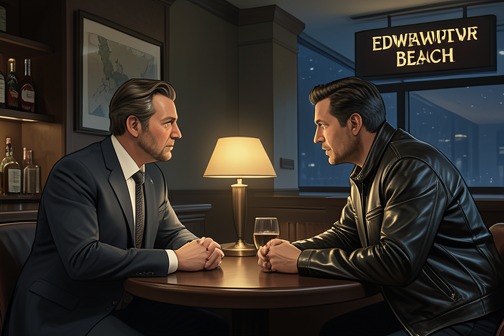
Sheeran spent time at the [Edgewater Beach Hotel](entity:location-recall-location-edgewater-beach-hote-33c5f634b81b) with Hoffa, [Bill Isabel](entity:character-recall-character-bill-isabel-63a87a5e5328), and [Sam Portwine](entity:character-recall-character-sam-portwine-bd5b482a78b0), where he met [Sam Giancana](entity:character-recall-character-sam-giancana-e6b1743c2045) and [Jack Ruby](entity:character-recall-character-jack-ruby-df4ae16cad27). He also heard Hoffa and Giancana argue about the coming presidential election and whether the [Chicago](entity:location-recall-location-chicago-eb77a855d5aa) outfit should help [John F. Kennedy](entity:character-recall-character-john-f-kennedy-3cac4eb2c6d3).
Hoffa distrusted the Kennedy family and warned that [Robert F. Kennedy](entity:character-recall-character-robert-f-kennedy-96fd597c408b) would continue his campaign against organized crime. Sheeran later described the conversations as a startling glimpse into national politics conducted among mob and union leaders.
1961
Local 777’s Secession Fight
In [Chicago](entity:location-recall-location-chicago-eb77a855d5aa), members of [Teamsters Local 777](entity:organization-recall-organization-teamsters-local-b5d3222d46a3) organized to leave [Joey Glimco](entity:character-recall-character-joey-glimco-dd4924f2cea4)’s control, with [Paul Hall](entity:character-recall-character-paul-hall-c388ba4cbce8) and the [Seafarers International Union](entity:organization-recall-organization-seafarers-intern-f1acf1f597fd) backing the breakaway faction. Sheeran was sent to intimidate the rebels and described confronting a crowd of roughly fifty men after his two companions fled.
The rebels won the election and affiliated with the [AFL-CIO](entity:organization-recall-organization-afl-cio-14e1c59aedbf)-backed Seafarers. The defeat widened the conflict between Hoffa’s organization and rival unions, and Sheeran later recalled further acts of sabotage and street violence in the dispute.
1961
The Philadelphia Hall Assault
As the Seafarers conflict spread to [Philadelphia](entity:location-recall-location-philadelphia-375889b6054c), Sheeran led a group of Teamsters into the union hall used by [Paul Hall](entity:character-recall-character-paul-hall-c388ba4cbce8)’s men. He drove a truck through the plate-glass wall at dawn, and the group attacked the sleeping occupants before escaping.
Sheeran called the assault a message job rather than an attempt to cause serious injury. The episode shows how labor organizing and organized violence had become inseparable in the environment around him.
1961
The Bay of Pigs Delivery
On Hoffa’s instructions, Sheeran collected a truck from Phil Milestone and drove military uniforms, weapons, and ammunition from a concrete plant in [Baltimore](entity:location-recall-location-baltimore-08e9037772fe) to a [Florida](entity:location-recall-location-florida-1618e1042117) dog track. He said the equipment came from the Maryland National Guard and was handed to anti-Castro Cubans and [E. Howard Hunt](entity:character-recall-character-e-howard-hunt-659940e3b281).
Bufalino later told Sheeran that the shipment related to a coming operation in [Cuba](entity:location-recall-location-cuba-419261c764da). The [Bay of Pigs invasion](entity:event-recall-event-36c7a66f493f) failed after President [John F. Kennedy](entity:character-recall-character-john-f-kennedy-3cac4eb2c6d3) withheld the air cover the invaders needed, leaving the men on the beach vulnerable to capture and death.
1961–1962; revealed in 1975
The Cuba Assassination Plots
Sheeran recalled hearing about efforts involving the CIA and organized-crime figures to recover their lost Cuban holdings and assassinate [Fidel Castro](entity:character-recall-character-6029cd696dd4). He said he never heard a direct plan discussed, though he connected Bufalino, Giancana, [Carlos Marcello](entity:character-recall-character-carlos-marcello-9cade689cf90), and [Santo Trafficante](entity:character-recall-character-santo-trafficante-ab2be4e65fb5) to the broader network.
Years later, the [Senate Church Committee](entity:organization-recall-organization-95ca53eab936) investigated the CIA–Mafia plots. The revelations placed Sheeran’s account of the weapons shipment within a larger and murkier relationship between the government and the criminal world.
1963
The Master Freight Agreement
Hoffa secured the first nationwide [Master Freight Agreement](entity:object-recall-object-master-freight-agreeme-99a4884817e7) after years of negotiations with trucking companies and pressure within the union. Sheeran joined the National Negotiating Committee and saw the agreement as a major improvement in wages, pensions, and benefits.
The agreement also required a more unified union, strengthening Hoffa’s opposition to internal factions. Sheeran believed its promise to workers justified the hard tactics used to defeat dissent, even when those tactics involved violence.
Summer 1962, as recounted during the later investigation
The Alleged Kennedy Threat
Teamsters official [Edward Grady Partin](entity:character-recall-character-edward-grady-partin-d858006996d6) later told [Robert F. Kennedy](entity:character-recall-character-robert-f-kennedy-96fd597c408b)’s investigators that Hoffa had discussed killing the attorney general and described how it might be done. Partin passed a lie-detector test and became a key witness for the government.
Hoffa had mistaken the tough-looking Louisiana official for a man who could be trusted with such talk. The alleged threat added to the government’s case against him and made Partin’s later betrayal of Hoffa especially consequential.
October–December 1962
The Test Fleet Jury Tampering
Hoffa’s trial in [Nashville](entity:location-recall-location-nashville-f0352f44857f) concerned Test Fleet, a trucking company he had formed with Owen Bert Brennan through their wives. As the trial proceeded, jurors reported attempted bribes and suspicious contacts, and the judge removed several prospective or seated jurors.
Hoffa’s defense denied a fix, but Judge [William E. Miller](entity:character-recall-character-william-e-miller-dca6df10526e) dismissed the jury and condemned the efforts to subvert the trial. The case turned a misdemeanor dispute into a serious threat to Hoffa’s freedom and provided the basis for a separate prosecution.
September 1963
Valachi’s Public Testimony
[Joseph Valachi](entity:character-recall-character-joseph-valachi-54d998353092) appeared before the [McClellan Committee](entity:organization-recall-organization-mcclellan-commit-602e67c631c9) and described the structure and practices of organized crime. His testimony gave the public an unprecedented view of the Mafia, including its hierarchy and the threat posed by informing.
Hoffa and his allies saw Valachi’s appearance as a publicity weapon for [Robert F. Kennedy](entity:character-recall-character-robert-f-kennedy-96fd597c408b)’s campaign. The testimony intensified the pressure on criminal organizations and made the conflict between the government and Hoffa’s circle more visible.
A few days before November 22, 1963
The Rifles for Dallas
Bufalino sent Sheeran to Brooklyn, where [Tony Pro](entity:character-recall-character-bbbaf5be5f15) gave him a duffel bag containing three rifles. Sheeran carried the bag to the [Baltimore](entity:location-recall-location-baltimore-08e9037772fe) concrete plant and handed over the car keys to men connected to [Carlos Marcello](entity:character-recall-character-carlos-marcello-9cade689cf90)’s pilot, [Dave Ferrie](entity:character-recall-character-dave-ferrie-a2141caaaff7).
Sheeran said he did not know what the weapons were for. After President [John F. Kennedy](entity:character-recall-character-john-f-kennedy-3cac4eb2c6d3) was assassinated, he wondered whether the rifles were connected to the killing, but he had no one he could safely ask.
November 22, 1963
The Kennedy Assassination
News of President [John F. Kennedy](entity:character-recall-character-john-f-kennedy-3cac4eb2c6d3)’s assassination reached Sheeran while he was in [Wilmington, Delaware](entity:location-recall-location-50ec9239db9e). Though he had no personal affection for Kennedy, he was shaken by the murder and thought of the rifles he had delivered weeks earlier.
Hoffa reacted angrily when [Harold Gibbons](entity:character-recall-character-harold-gibbons-71de6e9afbd0) lowered the Teamsters headquarters flag in mourning. The episode sharpened the personal and political divisions within the union, while Sheeran’s unanswered suspicion tied his earlier delivery to a national tragedy.
January–March 1964
The Chattanooga Trial
After Hoffa’s lead lawyer [Tommy Osborn](entity:character-recall-character-tommy-osborn-61f528813079) was disbarred, the jury-tampering case moved to [Chattanooga](entity:location-recall-location-chattanooga-a9bf615ac93c). The prosecution called Partin, who testified that Hoffa had directed and discussed efforts to influence the [Nashville](entity:location-recall-location-nashville-f0352f44857f) jury.
The jury convicted Hoffa and several associates, while acquitting [Allen Dorfman](entity:character-recall-character-allen-dorfman-d7f8435f766c). Judge Frank Wilson sentenced Hoffa to eight years, describing jury tampering as an assault on the nation’s legal system.
April–August 1964
The Sun Valley Conviction
Hoffa went to trial in [Chicago](entity:location-recall-location-chicago-eb77a855d5aa) over the use of pension money connected to the failed [Sun Valley Village](entity:location-recall-location-sun-valley-village-097adb2ef7b9) development. Prosecutors argued that he had used pension-fund transactions to protect his own financial interest and repay money pledged to the project.
Hoffa denied signing the incriminating trust agreement, but on cross-examination he authenticated a lease bearing the same form of signature. The jury convicted him and he received five more years, bringing his consecutive sentence to thirteen years.
March 7, 1967
Hoffa Enters Lewisburg
After appeals failed, Hoffa entered federal prison at Lewisburg. His union successor, [Frank Fitzsimmons](entity:character-recall-character-frank-fitzsimmons-8afce6428ab2), remained outside, while Hoffa used visits from lawyers and carefully arranged contacts to keep influence over union affairs.
Sheeran visited Hoffa and helped him communicate with allies. The prison did not end Hoffa’s control so much as confine it, while the relationship between the imprisoned leader and his chosen successor began to shift toward distrust.
September 1967
The Local 107 Hall Gunfight
After Hoffa assigned Sheeran to help stabilize [Philadelphia](entity:location-recall-location-philadelphia-375889b6054c)’s Local 107, a violent factional clash erupted outside the union hall. Sheeran said he brought men from [Angelo Bruno](entity:character-recall-character-angelo-bruno-7b9540f1b2a1)’s circle to confront the forces aligned with [Joseph McGreal](entity:character-recall-character-joseph-mcgreal-98b47c68ec58), and gunfire broke out as the groups approached each other.
Sheeran escaped to Delaware, was arrested, and spent four months in jail before the case was dismissed on speedy-trial grounds. [Frank Fitzsimmons](entity:character-recall-character-frank-fitzsimmons-8afce6428ab2) refused to help with his expenses, leaving Sheeran resentful of the man who had sent him into the conflict.
November 1969
Hoffa’s Parole Defeat
Hoffa’s first parole application was denied while his [Chicago](entity:location-recall-location-chicago-eb77a855d5aa) appeal remained unresolved. He continued to expect that his allies and political connections might eventually secure his release.
His next chance would come in 1971, when a Teamsters convention could determine whether he regained control of the union. The delay intensified the struggle with Fitzsimmons, who was increasingly comfortable exercising power in Hoffa’s absence.
May 1971
The Nixon Cash Drop
Sheeran drove a suitcase containing roughly half a million dollars to the [Washington Hilton](entity:location-recall-location-89d7aa867cf4), where [John Mitchell](entity:character-recall-character-john-mitchell-403c00b69317) met him and took the money. Sheeran understood the payment to be connected with Hoffa’s efforts to obtain release and Nixon’s reelection, though the exact source of the cash was unclear to him.
The exchange embodied the bargain Hoffa believed he had made with the Nixon administration. It also set the stage for the surprise condition that would bar Hoffa from union management after his release.
June–August 1971
Hoffa’s Resignations
Facing another parole hearing, Hoffa resigned from his union offices and publicly endorsed Fitzsimmons as his successor. At the July convention, Sheeran found that Hoffa’s image had been removed from the hall and secretly restored it inside.
The parole board nevertheless rejected Hoffa’s application in August. The resignations had not won his freedom and left him weakened in the union, while Fitzsimmons remained in control.
December 23, 1971
Nixon’s Conditional Commutation
[President Nixon](entity:character-recall-character-d79868f311d8) commuted Hoffa’s sentence and released him from prison before [Christmas](entity:time-recall-time-0cffe7da2c4d). Sheeran recalled seeing the initial papers and believing they contained no restriction on Hoffa’s return to union office.
When the final order barred Hoffa from direct or indirect union management until 1980, the betrayal became clear. Hoffa had regained his freedom but lost the chance to reclaim the presidency at the 1976 convention.
1972–1973
Hoffa’s Return to Public Life
Hoffa kept a low profile while on parole, meeting allies and planning a challenge to the restriction on his pardon. He told Sheeran that he intended to defeat Fitzsimmons and return to the union, and Sheeran agreed to support the effort.
Hoffa’s parole ended in March 1973, freeing him to travel and speak more openly. His ambition to run again transformed the conditional release into a new phase of conflict with Fitzsimmons and the people who preferred the existing leadership.
April 7, 1972
The Gallo Killing
Sheeran later confessed that he shot [Joey Gallo](entity:character-recall-character-joey-gallo-90d3b6d49554) at a Little [Italy](entity:location-recall-location-italy-85c2492cd54b) seafood restaurant on Gallo’s birthday, after Bufalino’s people arranged the operation. He described entering alone, shooting Gallo and his bodyguard, and leaving with help from [John Francis](entity:character-recall-character-john-francis-e95f5dfabd2d).
The account contradicted the established story that three Italian gunmen had killed Gallo. Years later, [Charles Brandt](entity:character-recall-character-charles-brandt-f5bfd22917e1) reported that an eyewitness identified the shooter as a tall, Irish-looking man and recognized Sheeran from a photograph and video.
1972
The Delaware Newspaper Blockade
As president of [Teamsters Local 326](entity:organization-recall-organization-teamsters-local-381d71104915), Sheeran organized an informational picket line that prevented newspaper deliveries during the final week of the Delaware Senate race between [Caleb Boggs](entity:character-recall-character-caleb-boggs-16b942cd6d4f) and [Joe Biden](entity:character-recall-character-joe-biden-843a74551acb). Inserts carrying Boggs’s attacks on Biden remained in the warehouse until the election had passed.
Sheeran later said he did not know whether Biden had been aware of the maneuver. He remembered that Biden kept his promise to listen to the Teamsters after winning, while the episode remained a disputed feature of the campaign.
1973–1974
The Hoffa Restriction Lawsuit
Hoffa sued to overturn the union-management restriction on his commutation, arguing that the president lacked authority to attach such a condition to a pardon. Sheeran delivered money and later an affidavit from [John Mitchell](entity:character-recall-character-john-mitchell-403c00b69317) denying that the restriction had originated with him or Nixon.
The affidavit became compromised when Mitchell was convicted of perjury and obstruction in the [Watergate scandal](entity:event-recall-event-5777ca97f13d). Hoffa lost in district court and appealed, still believing he could win in time to run in 1976.
October 1974
Bufalino Opposes the Campaign
At Sheeran’s testimonial dinner, Hoffa received a warm reception and promised to make Sheeran an International organizer if he regained the presidency. But at a private meeting before the dinner, Bufalino told Hoffa that he should stop trying to take back the union.
Hoffa insisted that the union was his and that he would not allow Fitzsimmons to keep it. Bufalino warned that more powerful people were troubled by Hoffa’s talk, especially his references to Dallas, and instructed Sheeran to tell his friend what was at stake.
October 1974
Hoffa’s Warning of Exposure
At the Warwick Hotel after the private meeting, Hoffa told Sheeran that he had records and lists ready to be sent to the media if anything unnatural happened to him. He also claimed that the rifles Sheeran had delivered before Dallas had been intended for the Kennedy assassination.
Sheeran warned Hoffa that his threats were alarming their allies and urged him to keep people around him. Hoffa refused protection, insisting that bodyguards made a man careless and that nobody dared touch him.
1975, before July 30
The Disappearance Plot Takes Shape
Hoffa continued campaigning against Fitzsimmons and spoke publicly of exposing the mob’s influence over the pension fund. Behind the scenes, rumors circulated that he might be cooperating with the government, while his relationship with [Tony Pro](entity:character-recall-character-bbbaf5be5f15) remained poisoned by a pension dispute and earlier threats.
As the wedding of Bufalino’s goddaughter approached, Sheeran later understood that the gathering would bring criminal leaders to [Detroit](entity:location-recall-location-detroit-c63f400ec324) and provide cover for a meeting. Hoffa expected to reconcile with Tony Pro and trusted that Sheeran and Bufalino were still his friends.
June 19, 1975
Giancana’s Assassination
[Sam Giancana](entity:character-recall-character-sam-giancana-e6b1743c2045) was killed in his [Chicago](entity:location-recall-location-chicago-eb77a855d5aa) home days before he was scheduled to testify before the [Senate Church Committee](entity:organization-recall-organization-95ca53eab936) about the CIA and the Mafia’s anti-Castro operations. Sheeran remembered the killing as an ominous warning to men who spoke too freely.
The murder came only weeks before Hoffa disappeared and intensified concern about the dangers surrounding the committee’s investigation. It also reinforced the lesson that even powerful figures could be killed by people they trusted.
July 27, 1975
Hoffa’s Final Warning Call
From his [Philadelphia](entity:location-recall-location-philadelphia-375889b6054c) apartment, Sheeran called Hoffa at [Lake Orion](entity:location-recall-location-lake-orion-530e892ab5d4) with Bufalino’s permission. He urged Hoffa to abandon his campaign and warned him that people were concerned about his threats to expose the pension-fund dealings.
Hoffa agreed to meet [Tony Pro](entity:character-recall-character-bbbaf5be5f15) at a public restaurant and asked Sheeran to join him as backup. Sheeran accepted, believing the meeting might still give Hoffa a chance to make peace, and arranged to travel to [Detroit](entity:location-recall-location-detroit-c63f400ec324) with Bufalino.
July 28, 1975
The Meeting Is Changed
During dinner near Kingston, Bufalino told Sheeran that their plans had changed: they would not leave for [Detroit](entity:location-recall-location-detroit-c63f400ec324) until Wednesday, and there would be no need for a Saturday meeting with Hoffa. Sheeran understood that he was being kept away from the planned public meeting with [Tony Pro](entity:character-recall-character-bbbaf5be5f15).
When Sheeran warned that Hoffa’s disappearance would bring a federal backlash, Bufalino replied that there would be no body. He then told Sheeran a pilot would take him over the lake to Detroit for an errand, while the women continued the journey by car.
July 30, 1975, afternoon
Hoffa at the Red Fox
At the [Machus Red Fox Restaurant](entity:location-recall-location-3fa60a8892c9), Hoffa waited for [Tony Jack](entity:character-recall-character-c702441f773b) and [Tony Pro](entity:character-recall-character-bbbaf5be5f15), neither of whom arrived as expected. Sheeran was not there when promised, and Hoffa called his wife while waiting near the restaurant.
[Chuckie O’Brien](entity:character-recall-character-chuckie-o-brien-78ee9222d49e) eventually arrived in a familiar car with Sheeran and Sally Bugs. Hoffa was angry at the delay and at the unexpected presence of Tony Pro’s representative, but the sight of Sheeran helped persuade him that Bufalino was waiting at another meeting place.
July 30, 1975, later that afternoon
Hoffa Enters the House
In Sheeran’s account, O’Brien drove Hoffa, Sheeran, and Sally Bugs to the [Detroit](entity:location-recall-location-detroit-c63f400ec324) house where two men waited inside. Sally Bugs left with O’Brien, while Sheeran accompanied Hoffa through the front door, giving him the impression that the meeting with Bufalino was safe.
When Hoffa discovered that no one had come out to greet him, he turned toward the exit. Sheeran said he shot his friend twice in the back of the head, then left the house and returned to the plane waiting at [Pontiac airfield](entity:location-recall-location-08c73f5d12a8).
July 30, 1975, after the shooting
The Body’s Removal
Sheeran said two men cleaned the house, put Hoffa’s body in a bag, and removed it through the rear of the property. Bufalino later told him that the body had been taken away for cremation, though Sheeran did not know the final destination or the full chain of disposal.
After rejoining Bufalino and the women in Ohio, Sheeran drove with them into [Detroit](entity:location-recall-location-detroit-c63f400ec324). The murder left Hoffa missing without a body, while his family and investigators began a search that would last for decades.
August 1, 1975
The Wedding’s First Questions
At the wedding in [Detroit](entity:location-recall-location-detroit-c63f400ec324), Hoffa’s former associates asked Sheeran whether [Tony Pro](entity:character-recall-character-bbbaf5be5f15) had arranged the killing. Sheeran was already carrying the knowledge of his own role, but he did not openly describe what had happened.
The disappearance rapidly became the dominant subject among the guests. The men who had once trusted Hoffa now tried to determine which of their allies had betrayed him, while Sheeran returned to [Philadelphia](entity:location-recall-location-philadelphia-375889b6054c) with the secret between himself and Bufalino.
August 4, 1975
The Vesuvio Confrontation
Five days after Hoffa disappeared, Sheeran met Bufalino, [Tony Pro](entity:character-recall-character-bbbaf5be5f15), and Sally Bugs at the Vesuvio. Sheeran said the first meeting was a report to Fat Tony [Salerno](entity:location-recall-location-salerno-f0db2d865df7) about how the operation had been carried out; a second meeting followed when Tony Pro accused him of having been asked to kill Pro and Fitzsimmons.
Tony Pro threatened Sheeran, who answered that the danger ran both ways. Bufalino ordered the men to shake hands and then defended Sheeran, preventing the accusation from becoming a new killing feud.
August 3, 1975
Peggy Rejects Her Father
The day before the Vesuvio meeting, Sheeran visited his former wife Mary and found their daughter Peggy watching the news about Hoffa’s disappearance. She looked at her father and told him that she did not want to know a person like him.
Peggy had once been close to Sheeran, but she never spoke to him again after that visit. Her estrangement became one of the lasting personal consequences of the murder and the life Sheeran had chosen.
1975–1976
The Investigation’s Suspect Circle
The FBI assigned hundreds of agents to Hoffa’s disappearance and focused on a small circle that included Sheeran, Bufalino, [Tony Pro](entity:character-recall-character-bbbaf5be5f15), the Andrettas, Sally Bugs, [Tony Jack](entity:character-recall-character-c702441f773b), and [Chuckie O’Brien](entity:character-recall-character-chuckie-o-brien-78ee9222d49e). The men appeared before a grand jury and invoked the Fifth Amendment.
The investigation did not produce charges in the disappearance, but prosecutors pursued related crimes. Sheeran later suggested that the government’s focus on this group reflected knowledge that someone within it was providing information.
1964–1972
The Gorie Case and Sheeran’s Arrest
Sheeran denied that Hoffa ordered the 1964 killing of [John Gorey](entity:character-recall-character-john-gorey-d7ff998cbc4c) and Rita at the [Local 107 union hall](entity:location-recall-location-107-e879b946d3ef). He said Hoffa gave him money for the accused men’s lawyers because he had made a promise, not because he had authorized the killings.
In 1967, after a shootout involving a [Philadelphia](entity:location-recall-location-philadelphia-375889b6054c) union faction, Sheeran was charged in the death of [Robert “Lonnie” DeGeorge](entity:character-recall-character-robert-lonnie-degeo-fdfdd57ae7c9). The prosecution delayed the case for years, but a judge eventually dismissed it after finding that the Commonwealth had repeatedly postponed trial.
After the book’s first publication
The Gallo Witness Emerges
[Charles Brandt](entity:character-recall-character-charles-brandt-f5bfd22917e1) reported finding a witness to the Gallo shooting who said the killer was a lone gunman, not three Italians. After reviewing photographs and a video, she identified Sheeran as the tall, Irish-looking man she had seen at the restaurant.
Her account supported Sheeran’s confession but came decades after the event. Brandt treated the identification as a major corroboration, while acknowledging that the long delay made the testimony open to challenge.
March 21, 1978
Sally Bugs Is Killed
Sheeran later said that he and [John Francis](entity:character-recall-character-john-francis-e95f5dfabd2d) were sent to kill Sally Bugs, whom they suspected of meeting with the FBI without permission. Sheeran described greeting him on the street before Francis fired additional shots to make the attack sound like a gunfight.
Sally Bugs had been under heavy federal pressure over the Hoffa case and other murders. Brandt later considered whether the FBI had received information from him before he was killed, but the book does not establish what he told investigators.
1977–1979
Sheeran Faces the FBI
Sheeran appeared before grand juries and refused to cooperate, invoking legal protections or denying knowledge of the crimes investigators raised. In 1979, while he was drinking at the Cherry Hill Inn, [Charlie Allen](entity:character-recall-character-charlie-allen-3ff205ae56f6) asked him whether he had killed Hoffa; Sheeran recognized the question as an FBI operation and escaped.
The agents offered him protection and a reduced sentence if he would inform on Bufalino and [Angelo Bruno](entity:character-recall-character-angelo-bruno-7b9540f1b2a1). Sheeran refused, insisting that he would not become a rat even if it meant spending the rest of his life in prison.
1980–1982
The RICO Conviction
Sheeran went to trial on federal racketeering charges in 1980 and was acquitted of the principal charges. He testified in his own defense and faced [Charlie Allen](entity:character-recall-character-charlie-allen-3ff205ae56f6)’s account of alleged murders, including a claim that he had ordered a killing over spilled wine.
Other prosecutions brought convictions for labor-related offenses, including a taped threat against a company manager and the receipt of dynamite. Combined with a later federal sentence, the cases left Sheeran facing thirty-two years in prison.
1980s
Prison and Bufalino’s Decline
Sheeran served federal time at Sandstone, where the cold aggravated his arthritis and the FBI repeatedly offered him a chance to cooperate. He refused and later shared the prison hospital at Springfield with Bufalino and Fat Tony [Salerno](entity:location-recall-location-salerno-f0db2d865df7).
In their final conversations, Sheeran said that he and Bufalino regretted how far the Hoffa matter had gone. Bufalino’s illness and religious turn stayed with Sheeran, who began to believe that there was something beyond death and that his own crimes would require reckoning.
1991–1995
Medical Release and Return
Facing the possibility of paralysis, Sheeran received medical parole in 1991. The FBI continued to investigate him, and he was later returned to prison for a parole violation connected to drinking with [Philadelphia](entity:location-recall-location-philadelphia-375889b6054c) crime figures.
At a press conference, Sheeran announced that he would write a book and maintained that he would not inform. He left prison again in 1995, physically diminished but still determined to preserve the code that had governed his criminal life.
1999
The Absolution Meeting
Sheeran’s daughters arranged a private meeting with Monsignor Heldufor at St. Dorothy’s Church. Sheeran sought absolution so he could be buried in a Catholic cemetery and told Brandt that he believed there might be something after death.
After the meeting, Sheeran contacted Brandt and agreed to resume the interviews he had abandoned in 1991. His faith and fear of dying without reconciliation became the immediate force behind his decision to speak.
1999–2003
The Confession Begins
Brandt resumed interviewing Sheeran, drawing on his experience as a prosecutor and interrogator. Sheeran described his life in organized crime and admitted that he had carried out many killings, including the killing of Hoffa.
He read and approved chapters of the manuscript, though he sometimes became anxious and tried to withdraw admissions. Brandt saw confession as a process of fits, evasions, and returns, with Sheeran struggling to relieve his guilt without betraying the people he still considered his own.
Around 2001
The Forged Hoffa Letter
Sheeran gave Brandt a typewritten letter he said [Jimmy Hoffa](entity:character-recall-character-jimmy-hoffa-b893428a16ef) had written after the 1974 testimonial dinner. The letter included material Sheeran had long discussed, but it also supported an alternative version of the events that he could use if he changed his mind.
A forensic examination revealed that the paper was manufactured in 1994 and that the signature had been copied. The publisher canceled the book, and Sheeran later admitted that the forgery had been insurance in case the pressure became unbearable.
November 2003
The Deathbed Confirmation
During his final illness, Sheeran agreed to appear on camera and stand behind the book’s account of Hoffa’s disappearance. Brandt asked whether the events in the manuscript were things Sheeran had told him and whether he stood behind them; Sheeran answered that he did.
Sheeran was weak and reluctant to discuss details, but the recording captured his public confirmation of the confession. He had received communion and told Brandt he was at peace, though one final revelation about a real-estate man would remain incomplete.
November 2003
The Real Estater Revelation
During the final interview, Sheeran mentioned that a real-estate man had been involved with the [Detroit](entity:location-recall-location-detroit-c63f400ec324) house. When Brandt asked for more, Sheeran told him he had enough and warned him not to probe.
Sheeran died without identifying the man or explaining his role. Brandt later learned that [John Francis](entity:character-recall-character-john-francis-e95f5dfabd2d) had been a wealthy commercial real-estate agent, raising the possibility that he had helped secure the house, but the connection remained unproven.
December 14, 2003
Sheeran’s Death
Sheeran died after weeks of declining health, six weeks after his final recorded confirmation. He had asked Brandt to pray with him and had arranged, with his daughters, for a green coffin and a place in a Catholic cemetery.
At his funeral, a former cellmate recalled Sheeran’s fighting nature and the violence that had followed him into prison. The death ended the possibility of further questioning, leaving the book and its claims to stand in the public record.
2002
The FBI File Release
After years of pressure from the Hoffa family and journalists, the FBI released a censored summary of its investigation and portions of the larger case file. The documents showed that the investigation had focused intensely on a limited circle of suspects.
The released material did not resolve the disappearance, and the FBI declined requests to provide the full files to local investigators. Brandt argued that the agency’s secrecy concealed both unfinished leads and the possibility that an informant had been exposed.
February 2002
The Detroit House Search
Brandt drove Sheeran to [Detroit](entity:location-recall-location-detroit-c63f400ec324) to locate the house described in the confession. Sheeran was anxious and imagined that Hoffa’s surviving allies might be waiting for him, but he eventually confirmed the quiet house near the footbridge.
The location and exterior matched Sheeran’s directions, and Brandt later entered the house with its current owners. The interior, including the small vestibule and hallway, matched Sheeran’s description, though the rear door he remembered had been removed during renovations.
September 7, 2001
The Hair DNA Result
The FBI announced that DNA testing of a strand of hair found in the maroon Mercury connected it to Hoffa. The finding showed that Hoffa had been in a car investigators had long suspected was involved in his disappearance.
Brandt treated the result as important corroboration of Sheeran’s account that Hoffa had entered the car. It did not, by itself, prove who had killed Hoffa or where his body had gone.
2004–2005
Blood at the House
[Fox News](entity:organization-recall-organization-ffb95250aa99) arranged for investigators to test the [Detroit](entity:location-recall-location-detroit-c63f400ec324) house with Luminol, finding small traces of blood along the route from the vestibule toward the kitchen. Police later sent flooring to the [FBI Laboratory](entity:organization-recall-organization-a567e5fe3dfd) for analysis.
The laboratory identified human male blood but found that its DNA did not match Hoffa’s. The result neither confirmed nor disproved Sheeran’s confession, leaving the blood’s source and the house’s exact role uncertain.
After publication of the book
The Informant Question
Brandt continued seeking records about the suspects and the possibility that Sally Bugs had become an FBI informant. [Joe Coffey](entity:character-recall-character-joe-coffey-ee446ad5ebe9) told him that [John Francis](entity:character-recall-character-john-francis-e95f5dfabd2d) had been a substantial real-estate figure, not merely a driver for Bufalino.
A reporter also found that the former owner of the [Detroit](entity:location-recall-location-detroit-c63f400ec324) house had moved out before the murder and rented a room to a mysterious man. These discoveries suggested possible connections among Francis, the house, and its temporary occupant, but no record in the book conclusively joined the dots.
2005
An Unresolved Last Chapter
Brandt argued that Sheeran’s directions, the house’s interior, the hair in the Mercury, and the reported blood traces formed a cumulative case for the confession. He also recounted the Gallo eyewitness’s identification and the support the book received from crime writers and investigators.
Yet the Hoffa case remained officially unresolved, the FBI withheld most of its files, and the DNA from the house did not match Hoffa. The book closes not with a judicial verdict but with Brandt’s claim that Sheeran’s account explains the disappearance, alongside the unanswered questions that survive it.